Why Your AI Images Look Generic (And How to Fix It With One Simple Framework)
Here’s what most people type:
A cat.
The AI does what you asked. A cat appears.
But that’s not a strategy. That’s luck.
Now look at the evolution:
A cat
A photo of a cat on a pillow near a window
A portrait photo of a ginger cat sleeping on a linen pillow near a north-facing window, soft morning sun, 35mm lens, f1.4, shallow depth of field, leading lines, warm tones
Same subject. Completely different result.
The difference isn’t the tool.
It’s the specificity.
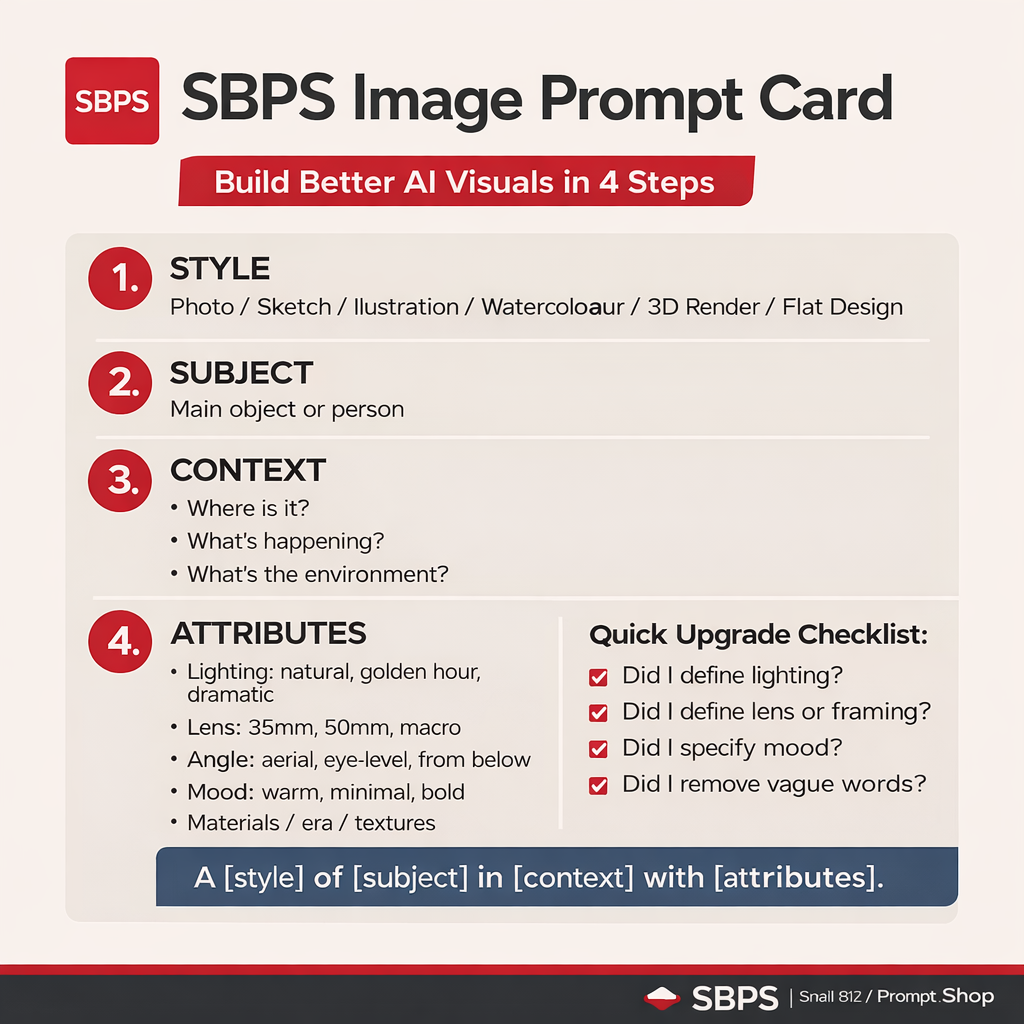
The SBPS Image Prompt Framework
Every strong visual prompt has four parts:
Style – What type of image? (photo, sketch, watercolour, 3D render)
Subject – What is the main object/person?
Context – Where is it? What’s happening?
Attributes – Lighting, lens, composition, materials, era, effects
The formula:
A [style] of [subject] in [context] with [attributes].
Simple. But powerful.
This is the same thinking we apply to copy prompts. Vague prompts produce generic output. Structured prompts produce control.
Example for SBPS Audience (Small Business Use Case)
Let’s say you want a hero image for a blog about small business strategy.
Weak prompt:
A small business owner working on a laptop.
Better:
A photo of a female small business owner working at a wooden desk in a bright Melbourne home office.
Strategic prompt:
A professional lifestyle photo of a confident female small business owner reviewing marketing analytics on a laptop in a modern Melbourne home office, natural window light, neutral tones, shallow depth of field, 50mm lens, clean background, subtle greenery, minimal styling.
Now you have:
• Brand alignment
• Geographic context
• Lighting control
• Visual tone
• Marketing relevance
That’s not just an image. That’s positioning.
Why This Matters for Small Businesses
AI-generated images are becoming everywhere.
The brands that stand out will:
• Control visual consistency
• Use lighting intentionally
• Define mood
• Think in brand palettes
• Avoid “AI look” generic outputs
You already do this with typography and tone of voice.
This is just visual prompting discipline.
Your next step
Not sure where AI fits in your business yet?
Take the 2 minute AI Readiness Check. You get tailored next steps and a free resource based on your score.
Take the free check