Understanding the AI Tool Stack: Where ChatGPT, Claude, and AI Builders Actually Fit
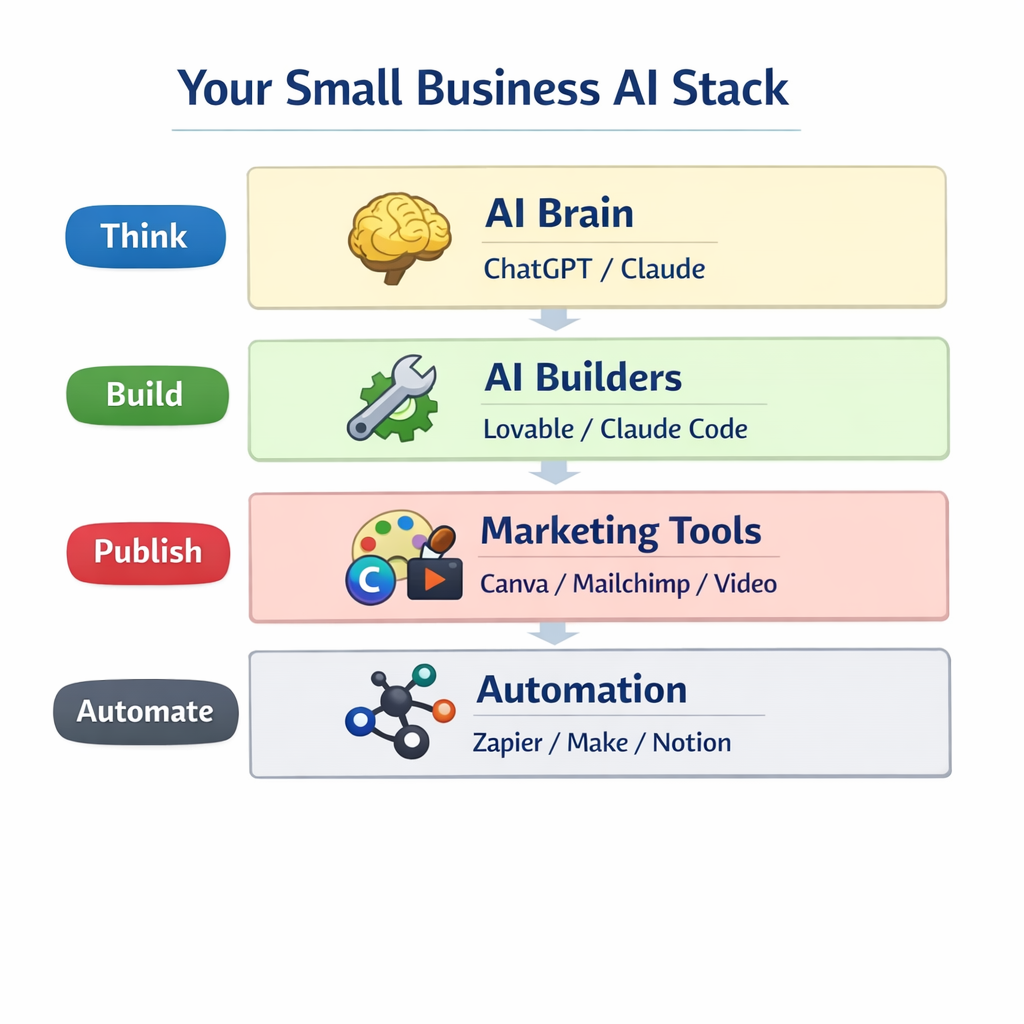
What does your AI stack look like?
Understanding the AI Tool Stack
Artificial intelligence tools are appearing everywhere.
You’ve probably heard about tools like ChatGPT, Claude, and newer platforms like Lovable.
For small businesses, the challenge isn’t access to AI.
The challenge is understanding how these tools actually fit together.
Most people think of AI as a single product. In reality, AI operates more like a technology stack with several layers, each performing a different role.
Once you understand these layers, it becomes much easier to decide which tools your business should actually use.
The Five Layers of the Modern AI Stack
Think of AI like a building with multiple floors. Each floor provides a different capability.
1. Foundation Models — The AI Brain
At the bottom of the stack are the foundation models.
These are the large AI systems trained on vast datasets that power everything else.
Examples include:
ChatGPT
Claude
Gemini
These systems are incredibly capable, but they are also general-purpose.
They don’t automatically know:
your business
your customers
your processes
your marketing strategy
That knowledge needs to be added through other layers.
2. Agent Tools — AI That Can Execute Tasks
The next layer introduces AI agents.
Instead of just answering questions, these systems can interact with software and perform actions.
One example is Claude Code, which allows AI to work directly inside a software project.
Agent tools can:
edit code
run commands
analyse software systems
fix bugs
These tools are mostly used by developers, but they are becoming the engine behind many AI products.
3. AI Builders — Tools That Create Applications
This layer is where things get interesting for small businesses.
AI builders allow you to create useful digital tools without writing code.
Platforms like Lovable make it possible to generate:
quizzes
calculators
scoring tools
lead generation tools
simple applications
For example, a small business might create:
a renovate vs relocate calculator
a roof safety risk assessment
a screening cost calculator
These tools turn passive website visitors into engaged prospects.
4. Custom GPTs — Your Business Intelligence Layer
Above the technical layers sits something even more valuable.
Your knowledge.
Custom GPTs allow businesses to embed their:
marketing frameworks
brand voice
service models
internal processes
client knowledge
into AI systems.
Instead of asking generic questions like:
“How should I market my service?”
A custom GPT already understands:
your industry
your positioning
your offers
your audience
This means the AI can deliver far more useful and relevant answers.
For many businesses, this layer becomes the operating system for marketing and strategy.
5. Business Tools — The Real Outcome
At the top of the stack are the tools that customers actually interact with.
These might include:
lead generation quizzes
pricing calculators
diagnostic tools
AI advisors
These tools sit on your website and provide value while capturing leads.
For example:
A visitor might complete a short diagnostic tool that tells them:
“Based on your answers, your facility roof safety risk is high.”
That result naturally leads to a sales conversation.
Why This Matters for Small Businesses
Many businesses are experimenting with AI by asking it to write:
blog posts
social media captions
email drafts
That’s useful, but it only scratches the surface.
The real opportunity comes from combining multiple layers of the AI stack.
For example:
AI models provide intelligence
Custom GPTs apply business knowledge
AI builders create tools
Lead tools capture prospects
The result is a powerful marketing system, not just a chatbot.
The Future of AI for Small Business
The businesses that benefit most from AI won’t simply use it to generate content.
They’ll use it to build smarter customer experiences.
Instead of static websites, businesses will offer tools that help visitors:
diagnose problems
compare options
calculate costs
prioritise decisions
These tools provide value first — and naturally generate leads.
Final Thought
Artificial intelligence is evolving quickly, but the core principle is simple:
AI works best when you combine tools, not rely on just one.
Understanding the AI stack helps small businesses move from experimenting with AI to building real systems that generate results.