A full-time offshore virtual assistant costs around A$1,000 to A$1,800 a month. Claude Pro costs US$20 a month. But they don't do the same job, so price alone is the wrong comparison. Train Claude first on the writing and thinking work, then hire a VA for what's left: the calls, the chasing and the follow-through.
Key takeaways
• A VA rate card sent to us in October 2026 prices a full-time offshore VA at AUD 1,025 to AUD 1,775 a month, depending on role and experience.
• Claude Pro is US$20 a month, which shows as about A$34 including GST on monthly billing.
• Claude is strong at drafting, summarising, sorting and planning. A VA is better at anything that needs a person: phone calls, chasing, and owning a task from start to finish.
• Either way, you are training someone. Write your process down once and it works for both.
• Most rate cards are priced for about 173 hours a month. Buy for the hours of help you actually have.
What do we mean by "training Claude"?
Training Claude doesn't mean anything technical. It means giving Claude your business context and your rules once, so it does a task your way every time instead of starting from scratch in every chat.
In practice that's two things. A Project is a workspace with its own chat history and knowledge base, where you upload your documents and add instructions that apply to every chat inside it [5]. A skill is a folder of instructions Claude loads to do a specific task the same way every time, like writing in your brand voice [6]. Projects get you most of the way. Skills come later, once a task is worth locking in.
I run both of my businesses this way, with a Claude Project for each one holding the brand voice, the offers and the rules. It's the closest thing to a VA who never needs the process explained twice.
What does a virtual assistant actually cost in Australia?
A full-time offshore VA, often based in the Philippines, costs roughly A$1,000 to A$1,800 a month. An Australian-based VA typically charges by the hour, at about A$35 to A$65 an hour according to one Australian VA agency [3].
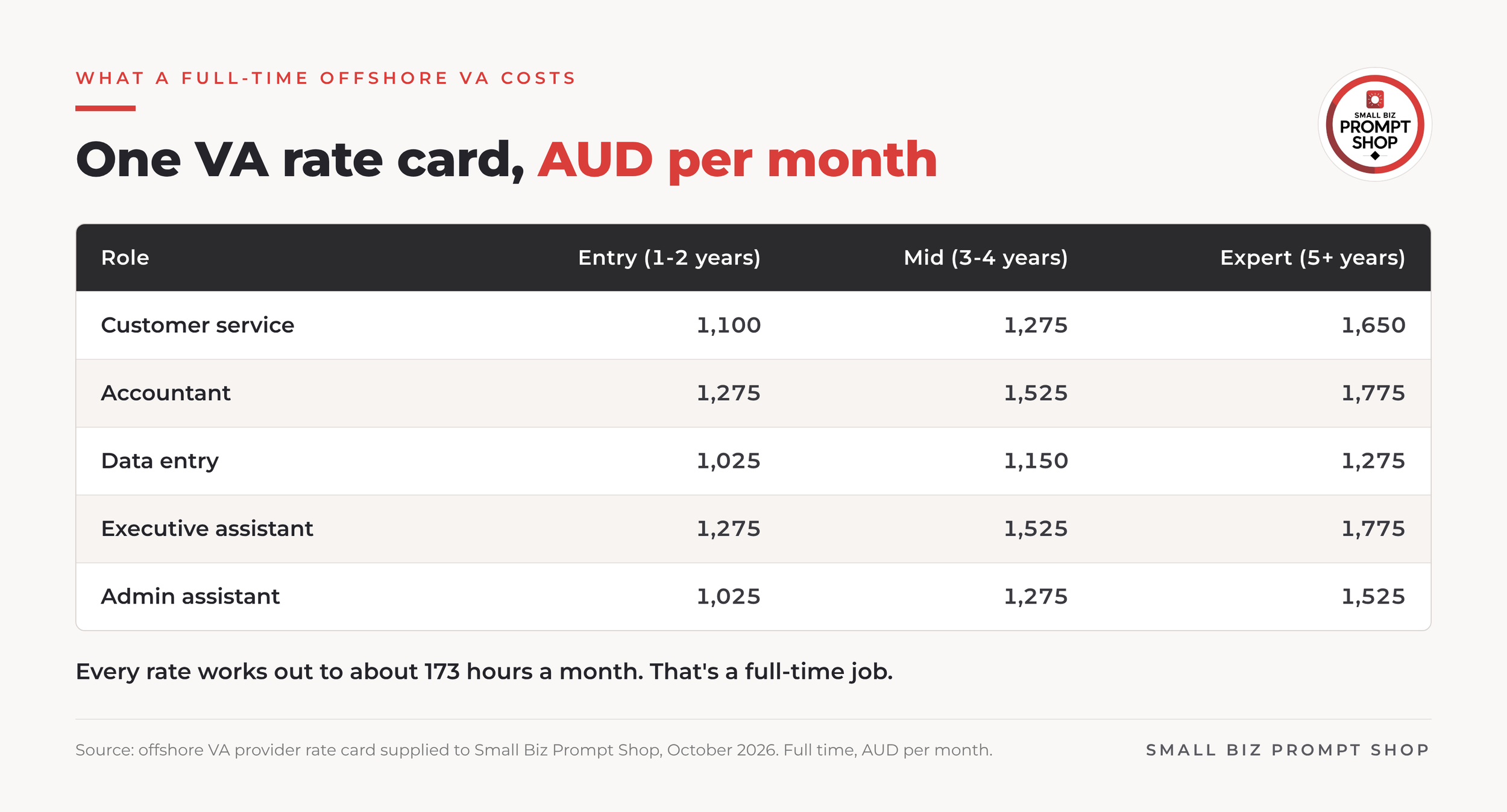
Here's a real rate card an offshore VA provider sent us in October 2026. We've left their name off, because the point is the shape of it, not the supplier.
Offshore VA rate card, full-time, AUD per month (supplied to SBPS, October 2026)
Those numbers line up with what's being advertised. Recent job ads for Philippines-based VAs working Australian hours list AUD 1,200 to AUD 1,500 a month, and AUD 1,600 to AUD 1,800 for a more senior general VA role [2].
Now look at the hourly rates on that card: AUD 6.35 for an entry-level customer service VA, rising to AUD 10.24 for an expert. Divide the monthly price by the hourly rate and it comes out at about 173 hours a month, every time. That's a full-time job.
That's the catch nobody puts on the rate card. It's built for a business with 40 hours a week of admin. If you've got eight hours of it, a full-time VA is a bigger-business answer to a small-business problem.
What does Claude cost, and what do you get?
Claude Pro is US$20 a month, or US$17 a month if you pay annually [4]. Anthropic charges in local currency where it can, and some regions include tax in the price you see [4]. From Australia that shows as about A$34 a month including GST, or A$28 a month on annual billing [7]. Your checkout screen is the price that counts.
For that you get Projects, skills, and the ability to hand off and schedule tasks [4][8]. There's also a free plan, which is fine for testing the idea but has tighter limits [4].
So on price alone, Claude wins by a mile. But you're not buying a price. You're buying hours of work done well, and that's where the two split.
Which tasks suit Claude, and which need a VA?
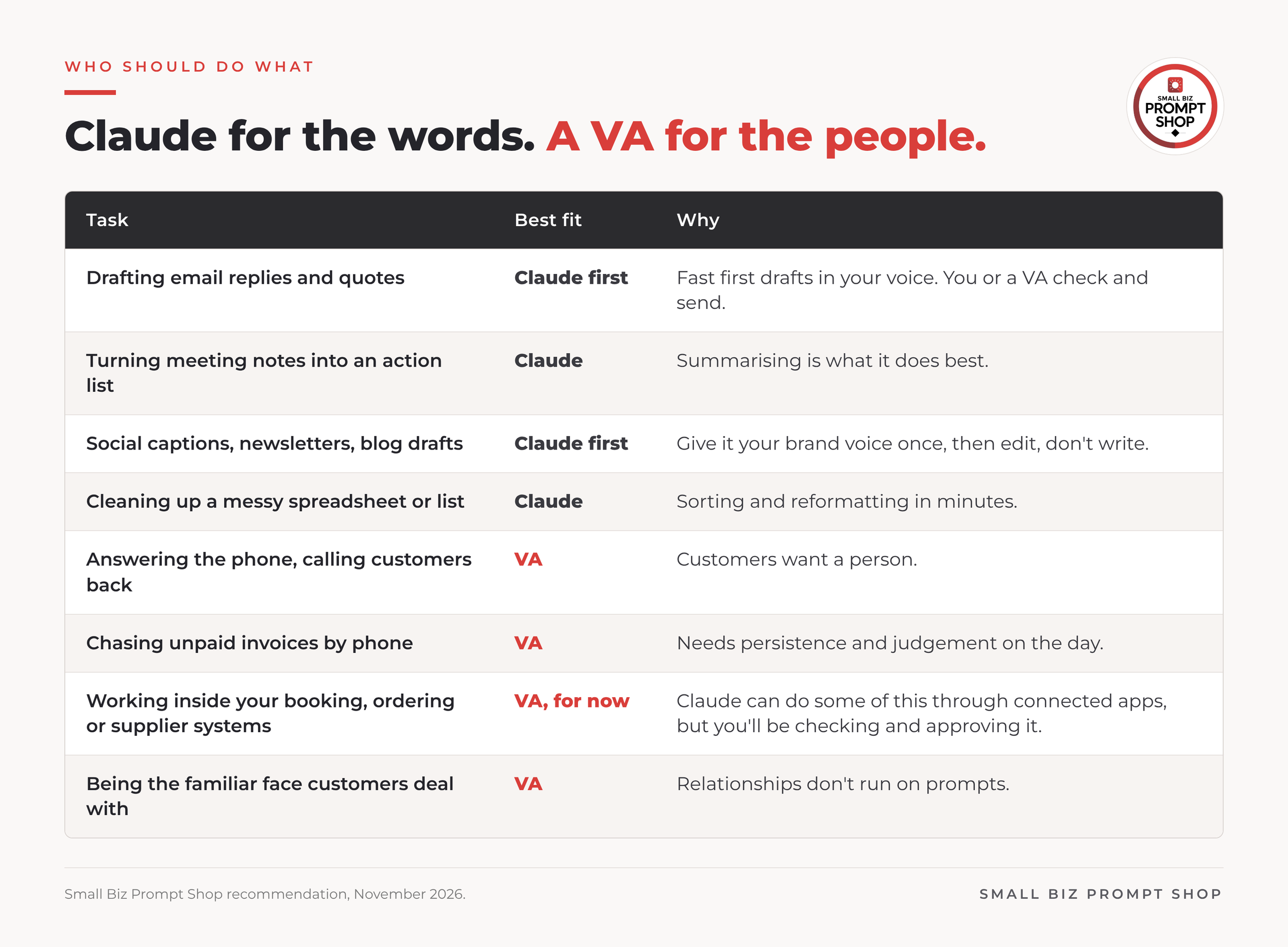
Claude suits the words: anything you'd write, summarise, sort or plan. A VA suits the people and the doing: anything that needs a phone, a relationship, or someone who owns a task until it's finished.
Isn't the real cost the training?
Yes, and it's the same cost either way. A new VA needs your processes explained, your examples, your tone and your "never do this" list. So does Claude.
The difference is where the training lives. With a VA, a lot of it lives in their head, and if they move on, it goes with them. With Claude, it lives in written instructions and files inside a Project, and every new chat in that Project starts with them [5].
Here's the bit most people miss: train Claude first, and you've written your VA's onboarding manual by accident.The instructions you give Claude are the same ones a person needs. Your services and prices, your best past replies, what to escalate to you. Write it once, use it twice.
How do you train Claude to do a VA-style task?
Start with one task you do every week, and set aside about an hour.
1. Pick one repeat task. Quote enquiries, booking confirmations, or your weekly newsletter. One, not five.
2. Create a Project and name it after the task. For example, "Quote replies".
3. Upload what a new staff member would need. Your services and prices, three of your best past replies, and your common questions and answers.
4. Write the instructions like a staff brief. Who you are, who your customers are, how you sound, what you never say or promise, and when to hand it back to you.
5. Test it on five real examples. Where it gets something wrong, don't just fix the reply. Add the correction to the instructions so it sticks.
6. Lock it in once it's reliable. If you use it every week, turn it into a skill so it runs the same way every time.
If writing the brief is the hard part, our AI Training for Small Business page sets out the ways we help owners set this up.
When should you hire a VA instead?
Hire a VA when your bottleneck is doing, not writing. That usually looks like this:
• Your customers need someone on the phone or on chat during business hours.
• You've got a regular block of hands-on admin every week, like processing orders, updating systems or chasing payments.
• You want someone to own a whole process end to end, not just do the first draft.
• You have time to manage someone. A VA is a working relationship, not a subscription.
And the best setup for most small businesses is both. Claude drafts, your VA checks, personalises and sends. Hand your VA the same instructions you wrote for Claude on day one.
The two-column test to run before you hire
Here's the decision, made simple. Write down everything you'd hand a VA. Then mark each task:
• W for words: writing, summarising, sorting, planning.
• P for people and doing: calls, chasing, logging into systems, owning a task.
Train Claude on the W column this month. Then add up the hours in the P column. If it's a few hours a week, a part-time or Australian-based VA by the hour is probably enough. If it's close to full time, that rate card starts to make sense, and you'll be hiring with an onboarding manual already written.
Frequently asked questions
Is Claude cheaper than a virtual assistant?
On price, yes. Claude Pro is US$20 a month, against roughly A$1,000 to A$1,800 a month for a full-time offshore VA. But they do different jobs, so compare the cost of getting each task done, not the subscription against the wage.
Can Claude replace a virtual assistant?
For writing, summarising and planning work, it often can. For phone calls, chasing payments and owning tasks inside your systems, not yet. Claude still needs you to check and approve its work.
How long does it take to train Claude for a task?
Set aside about an hour for your first Project: upload your documents, write the instructions and test it on real examples. It gets better every time you add a correction to the instructions.
Should I train Claude before hiring a VA?
Yes. You'll find out which tasks actually need a person, and the instructions you write for Claude become the onboarding manual for your VA.
Your next step
Pick one task from your W column and build its Project this week. If you'd rather do it with someone beside you, have a look at our AI Training for Small Business options, or start with the free AI Readiness Check to see where AI fits in your business first.