New data: Australian small businesses aren't behind on AI tools. They're behind on everything underneath them.
About a four-minute read.
Every small business owner I talk to has the same quiet worry: everyone else is further ahead with AI than I am.
New Australian data says that worry is aimed at the wrong thing.
Decidr's State of AI in Australian Business 2026 report surveyed just over 1,000 decision makers from businesses with 20 to 500 employees. The headline looks great: 71% say AI has significantly enhanced their operations and growth in the past year, up six points on 2025. Half now rate AI investment as urgent. Australian small businesses are not sitting this out.
But read past the headline and a different story shows up. The businesses in the survey use an average of 2.6 AI tools each — and only 23% say those tools are actually connected to the systems that run their business. Nearly half are experimenting with AI with no formal strategy at all. And 52% say they regularly lose time collecting, checking or re-entering information before AI can even use it.
The gap in Australian small business isn't a tools gap. Everyone has access to the same ChatGPT, Claude and Gemini — 66% of surveyed businesses use them. The gap is in what sits underneath the tools: a clear plan, connected systems, and business context the AI can actually work with.
The smallest businesses are trailing on every foundation measure
The report breaks results down by business size, and the pattern for the smallest band (20–49 employees) is consistent:
Only 26% have a clear AI strategy, against 44% once a business passes 50 employees. Only 19% have AI connected to their other business systems. Half haven't started updating their privacy policy for AI. On almost every readiness measure, the smallest businesses in the survey sit last — not because they're less interested, but because they're running AI as a collection of individual tools rather than a business capability.
Here's the line from the report worth sitting with: businesses of all sizes have access to similar tools and models. The wider gap is in the expertise, systems and governance needed to make those tools work across the business.
In other words — the thing you're missing isn't a subscription. It's a plan.
Why this is better news than it sounds
If the gap were money or technology, small businesses would genuinely be stuck. It's neither. Look at what's actually missing:
A strategy. Not a 40-page document. The businesses counted as having "a clear AI strategy and roadmap" have decided which parts of the business AI should help with, in what order, and how they'll know it's working. That's an afternoon of honest thinking, not an enterprise project.
Connection. The report found standalone AI tools make individual tasks faster, but connected AI makes the whole business smarter. For a small business, "connection" can be as simple as making sure your AI tools have access to the same customer information, price list and tone of voice — instead of every staff member pasting fragments into a chat window.
Context. More than half of businesses lose time re-entering information before AI can use it, and fewer than one in four hold complete information about their customers, processes or rules in a single connected place. AI can only reason from what it can see. A business brief you write once — who you serve, what you sell, how you sound — fixes more "generic AI output" problems than any clever prompt ever will.
Visibility. This one surprised me: 83% of businesses report at least some unapproved AI use by staff, and 72% say someone in the organisation has built their own AI tool — a prompt library, a workflow, an internal chatbot — in the past year. Your team is already using AI, whether you've sanctioned it or not. That's not a threat. It's free evidence of where AI is useful in your business. But you need to know it's happening before you can capture the value or manage the risk.
One deadline worth knowing about
The report flags a genuine compliance date: under changes to the Privacy Act, Australian businesses must update their privacy policy by 10 December 2026 if AI changes how personal information is collected, used, stored or shared. The rule applies to businesses with annual turnover above $3 million, plus some smaller businesses including health providers and those trading in personal information. If that's you and your privacy policy hasn't been touched since AI arrived in your business, put it on the list. (And check the detail with your adviser — this is a heads-up, not legal advice.)
What to do next
If you take one thing from the 2026 data, take this: the market is no longer divided by interest in AI. It's divided by readiness to act. And readiness, for a small business, comes down to four practical moves.
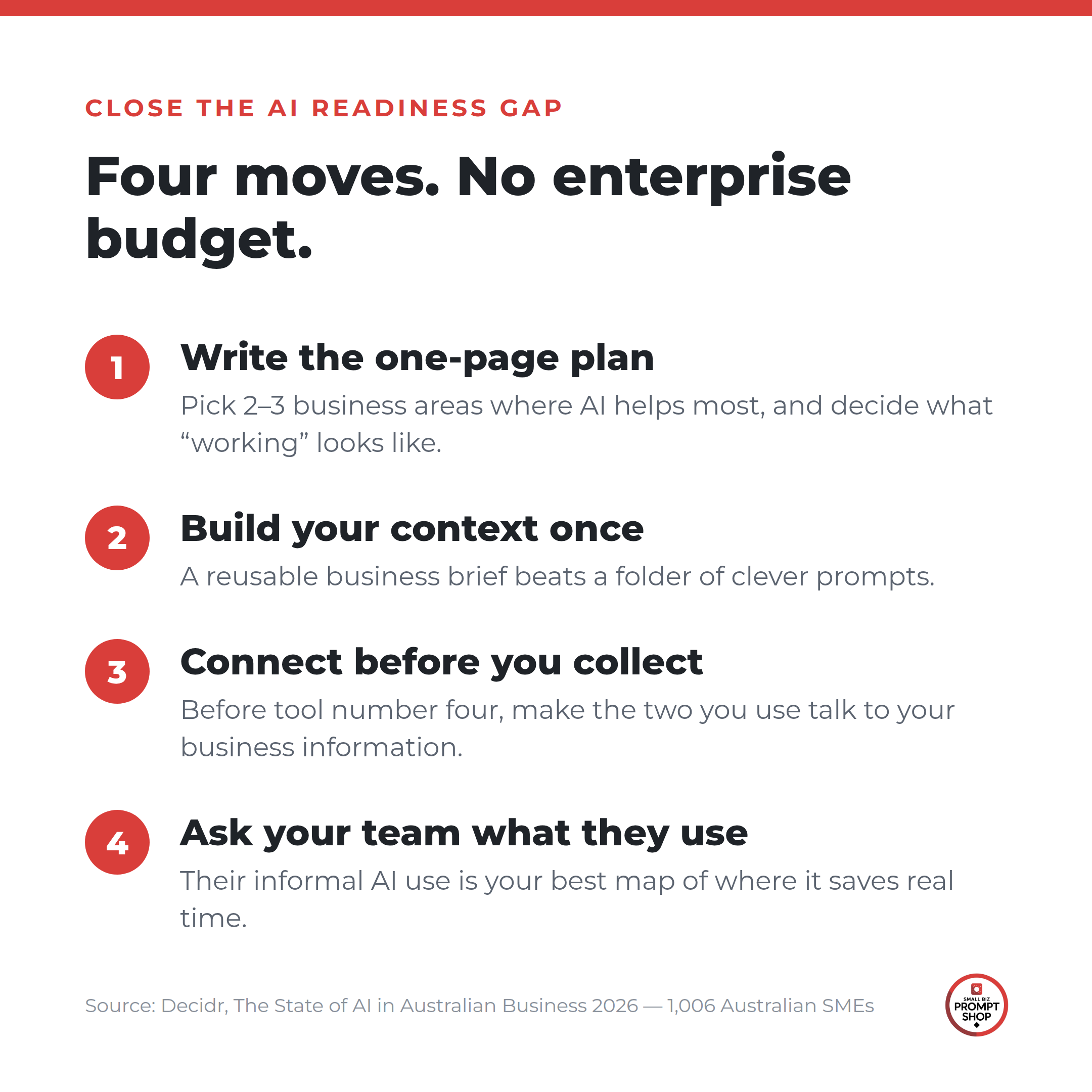
First, write the one-page plan. Pick the two or three business areas where AI helps most — the report shows businesses shifting from pure cost-cutting towards better and faster decisions — and decide what "working" looks like.
Second, build your context once. A reusable business brief beats a folder of clever prompts.
Third, connect before you collect. Before adding tool number four, make the two you actually use talk to the information they need.
Fourth, ask your team what they're already doing with AI. Amnesty, not audit. What they've built informally is your best map of where AI genuinely saves time in your business.
None of that requires a consultant on retainer or an enterprise budget. It requires deciding to treat AI as part of how the business runs, rather than a drawer of interesting tools.
You're not behind. But the gap between businesses that are ready and businesses that are dabbling is now measurable — and it's widening. The good news is that everything on the readiness side of the line is learnable.
If you want help closing the gap, that's exactly what Small Biz Prompt Shop is for — practical AI training, prompt packs built on real business context, and hands-on sessions like Prompt Hour that get your setup sorted in one sitting. Start there.
Your next step
Not sure where AI fits in your business yet?
Take the 2 minute AI Readiness Check. You get tailored next steps and a free resource based on your score.
Take the free check